
Track: Spine Disorders, Deformity and Functional Surgery
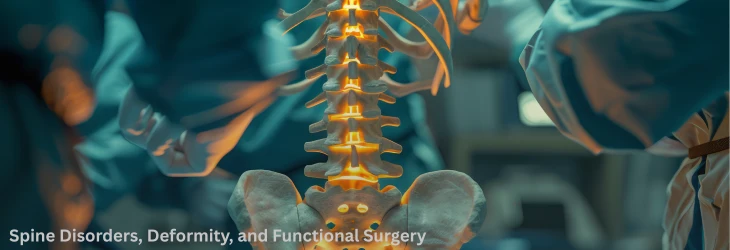
This session covers the full spectrum of spinal care, from common degenerative conditions treated with minimally invasive techniques to the complex deformity corrections that require multidisciplinary surgical teams. Attendees will explore both adult and pediatric deformity management.
The session also examines motion-preservation versus fusion strategies, advances in spinal trauma reconstruction, and the growing role of navigation, robotics, and AI in improving precision and outcomes, all measured against real-world functional and quality-of-life results.
With spine surgery among the fastest-evolving areas of orthopedics, this session gives attendees a comprehensive view of where the field is heading from technology-driven precision to patient-centered functional outcomes that define success.
Key Topics and Highlights:
Degenerative Spine Disease: Minimally invasive approaches to common spinal conditions. This session reviews which conditions are best suited to minimally invasive treatment.
Adult and Pediatric Deformity Correction: Surgical strategies across the age spectrum. Deformity correction goals and techniques differ meaningfully between a still-growing spine and a mature one.
Motion Preservation vs. Fusion: Comparing techniques and long-term outcomes. Motion-preserving technologies aim to reduce adjacent segment degeneration seen with fusion.
Spinal Trauma Reconstruction: Managing complex traumatic spine injuries. Attendees will review classification systems guiding surgical versus non-surgical management.
Navigation, Robotics and AI in Spine Surgery: Technology improving precision in spinal procedures. Navigation and robotic platforms are improving screw placement accuracy in complex spinal cases.
Functional Outcomes: Measuring quality-of-life impact of spine interventions. Success in spine surgery increasingly extends beyond radiographic correction to real-world functional improvement.
Scientific Highlights
- Orthopedic Surgery
- AI and Robotics in Orthopedics
- Orthopedic Radiology
- Trauma Reconstruction and Fracture Management
- Complex Arthroplasty and Arthroscopy
- Joint Preservation and Replacement
- Spine Disorders, Deformity and Functional Surgery
- Hand and Upper Extremity Surgery
- Advanced Foot and Ankle Surgery
- Pediatric Orthopedics
- Sports Medicine in Orthopedics
- Orthopedic Oncology
- Orthopedic Infections
- Rheumatology and Arthritis
- Metabolic Bone Diseases and Osteoporosis
- Orthopedic Physiotherapy
- Physical Medicine and Rehabilitation
- Musculoskeletal Disorders: Clinical Trials

Organization Location
1309 Coffeen Avenue, STE 1200, Sheridan, Wyoming 82801, USA
Mail us at
General Enquiry
contact@scientexconferences.com
Call us at
USA : (+1) 312 815 4231
Quick Links
Past Conferences
No past conferences available.
Past Webinar
No past webinars available.